Immigration Status Resolution Support Australia
Support Is Available
Immigration circumstances can change.
A visa may expire. An application may come to an end. Someone may find themselves holding a Bridging Visa E, without a valid visa, or uncertain about what they should do next.
For people in this situation, the most important message from Malak Foundation is simple:
Do not ignore the situation. Do not rely on rumours. Ask for help early.
The Australian Government has services specifically designed to help people understand and resolve their immigration status, including the Department of Home Affairs Immigration Status Resolution Service.
Malak Foundation is supporting this work within our communities by helping people understand that there are appropriate pathways to seek information, discuss their circumstances, consider available options and, where necessary, plan a supported voluntary return home.
Why this matters
At 30 June 2024, Australia had an estimated 75,400 unlawful non-citizens.
By 30 June 2025, that figure was estimated at 77,700 people.
These figures represent real people with very different circumstances.
Some may have overstayed a visa for a relatively short period. Others may have complex immigration circumstances. Some may be considering returning to their home country but do not know where to start.
The Department itself notes that people constantly move into and out of the unlawful non-citizen population as visas expire, people depart Australia and immigration circumstances are resolved.
The goal should therefore be to help people resolve their circumstances rather than remain outside the immigration system.
The Government already has a service to help
The Department of Home Affairs Immigration Status Resolution Service assists:
unlawful non-citizens;
Bridging Visa E holders; and
people in immigration detention.
Status Resolution Officers can help people:
understand their immigration status;
apply for a Bridging Visa E where appropriate; and
make arrangements to depart Australia.
This is an important service.
People should not assume that ignoring an immigration problem will make it disappear. Early engagement gives a person an opportunity to understand their circumstances and what steps may be available.
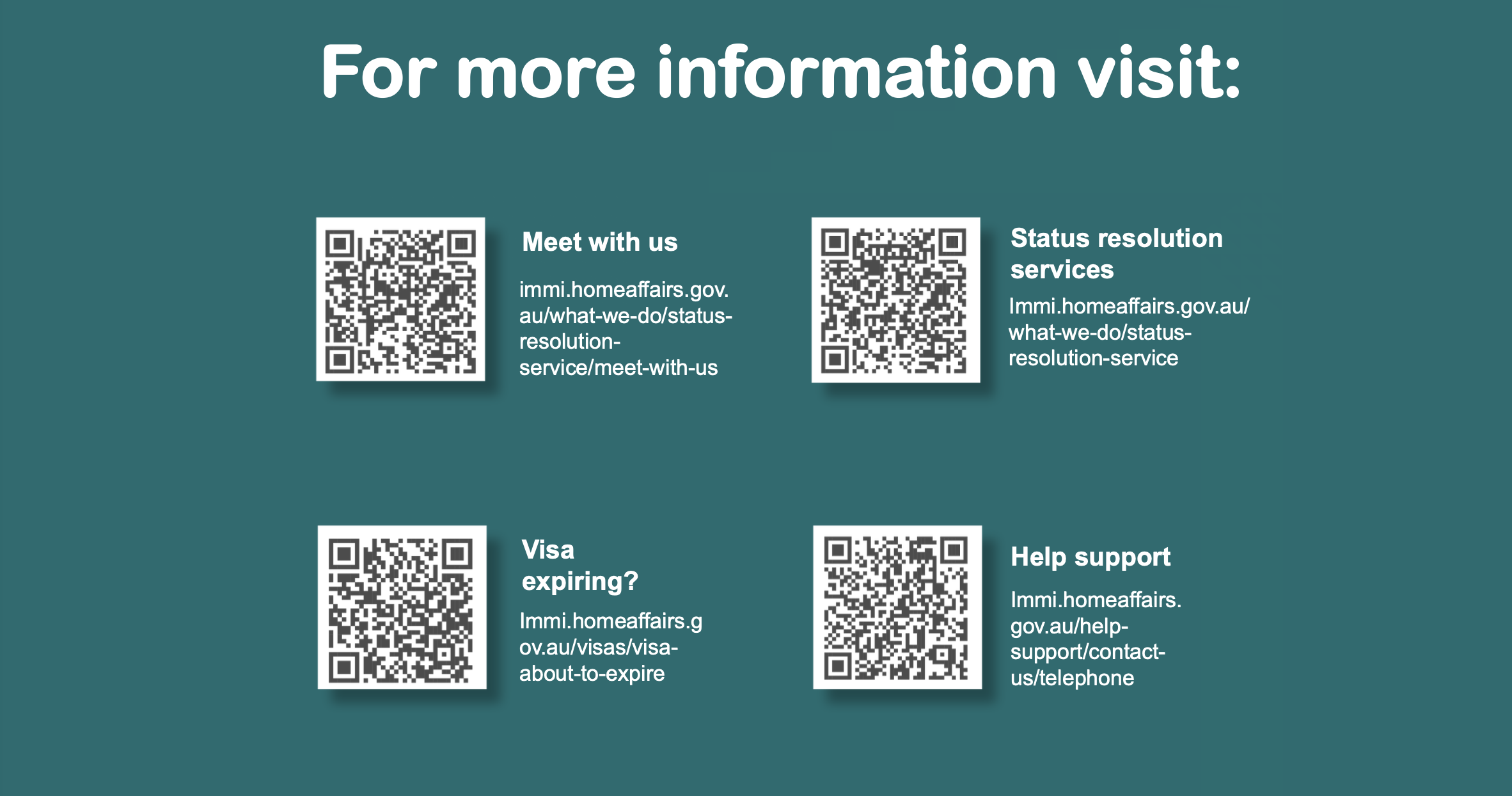
You can ask for an appointment
The Department provides a pathway for eligible people to request an in-person appointment in most capital cities.
The service allows people to discuss their immigration circumstances and available options.
A person must be in Australia and either hold a Bridging Visa E or not currently hold a valid visa to use this particular appointment service.
For some people, taking that first step can be intimidating.
This is where Malak Foundation can assist.
Speak with Malak Foundation
Malak Foundation has been engaging with multicultural communities to help people better understand available government services and encourage early resolution of immigration-status issues.
If you or someone you know is unsure what to do, Malak Foundation can help you connect with the appropriate service.
Where appropriate, we can:
explain what the Immigration Status Resolution Service does;
help you identify the appropriate service or referral pathway;
help you prepare for a Status Resolution appointment;
help organise the information you may need to take with you;
refer you to an appropriate registered migration agent or legal practitioner where professional immigration advice is required;
connect you with voluntary return and reintegration services; and
where practical and arranged beforehand, attend an appointment with you as a support person.
Malak Foundation does not decide visa applications and does not replace professional migration or legal advice.
Our role is to help make the pathway clearer and ensure community members know where appropriate help can be found.
Community members also have an important role
Helping someone you care about does not necessarily mean helping them avoid dealing with their immigration situation.
Sometimes the most helpful thing a friend, family member, employer or community leader can do is encourage that person to seek proper assistance.
If you know someone who may not have a valid visa, encourage them to contact an appropriate service rather than helping them remain outside the system indefinitely.
This is particularly important when employment is involved.
Australian law places responsibilities on employers and labour-hire organisations. Home Affairs states that it is against the law to hire a non-citizen who does not hold a valid visa or to employ a non-citizen in breach of their visa work conditions. Employers are expected to check relevant work rights through VEVO.
The Migration Act also contains specific civil and criminal provisions relating to allowing an unlawful non-citizen to work or referring an unlawful non-citizen for work.
So if someone asks you to provide undocumented work because they do not have work rights, do not put yourself, your business or that person at further risk.
Help them seek appropriate assistance instead.
What about providing accommodation?
Community members should also be careful not to deliberately assist someone to hide from immigration authorities.
Providing ordinary humanitarian help to a friend or family member should not automatically be described as an immigration offence. However, the Migration Act contains serious offences relating to concealing or harbouring an unlawful non-citizen, including circumstances involving an intention to prevent discovery by an officer.
If you are uncertain about your legal responsibilities, obtain appropriate legal advice.
The safest community response is not to help someone disappear further from the system.
Help them come forward and resolve the problem.
Support people — do not exploit them
There is another side to this issue that is equally important.
Someone's lack of immigration status does not give another person permission to exploit them.
Home Affairs makes clear that migrant worker exploitation is illegal, including where a worker has broken visa conditions or does not hold a valid Australian visa.
This means nobody should use another person's immigration circumstances to:
underpay them;
threaten them;
take their passport;
force them to work;
pressure them into unsafe accommodation; or
use the threat of immigration action to control them.
A person experiencing exploitation should seek help.
Supporting lawful immigration compliance and protecting vulnerable people are not competing goals. Both are important.
Considering returning home?
For some people, the best available pathway may be to return voluntarily to their home country.
The Australian Government's Return and Reintegration Assistance Program may provide eligible people with:
confidential return counselling and information;
assistance obtaining travel documents;
assistance purchasing flights; and
reintegration support after returning to their home country.
The presentation provided to community stakeholders identifies IRARA and Homeward among the return-assistance providers.
This is an important point that many people may not know.
A voluntary return does not necessarily mean simply buying a ticket and leaving without assistance.
Depending on eligibility and individual circumstances, support may be available to help someone prepare for departure and rebuild their life after returning home.
Planning your return can be better than waiting
The Migration Trends figures show that people continue to resolve their status and depart Australia.
In 2024–25, 6,646 compliance-related departures were recorded, comprising:
3,189 returns from the community, and
3,457 removals from immigration detention.
Where a person has no pathway to remain lawfully in Australia, engaging early may give them greater opportunity to understand voluntary return arrangements and available assistance rather than allowing circumstances to deteriorate.
Malak Foundation encourages people to seek information early and make informed decisions.
A Bridging Visa E may be relevant
A Bridging Visa E is a temporary visa that can allow an eligible person to remain lawfully in Australia while:
awaiting the final outcome of a substantive visa application; or
making arrangements to depart Australia.
Applications can be made through ImmiAccount free of charge.
Whether a Bridging Visa E or another immigration pathway is available depends on the individual person's circumstances.
Get qualified immigration advice
Friends, family members and community leaders can provide support, but immigration advice should come from appropriately qualified professionals.
The Department's community presentation identifies registered migration agents and legal practitioners as providers of immigration advice and directs people to OMARA to check whether a migration agent is registered.
Malak Foundation can help people connect with appropriate professional services where required.
Do not let fear or misinformation make the situation worse
People sometimes remain unlawful because they are frightened about what will happen if they speak to government.
Others rely on information circulating through friends, social media or informal community networks.
The Department of Home Affairs has specifically asked community organisations to help:
spread accurate information;
connect with people who may need assistance;
combat harmful immigration misconceptions;
encourage people to attend community engagements; and
identify effective ways of communicating with diverse communities.
Malak Foundation supports that approach.
The message we want to share with our community is not one of fear.
It is one of early action, accurate information and support.
If you know someone who needs help
If a friend, relative, employee or community member tells you that they may not have a valid visa:
Do not ignore the issue.
Do not offer unlawful employment.
Do not encourage them to hide or remain outside the system.
Do not exploit their vulnerability.
Instead:
encourage them to seek proper help.
You can also contact Malak Foundation and ask how we may be able to assist with an appropriate referral.
You do not have to navigate this alone
If you:
do not currently hold a valid Australian visa;
hold a Bridging Visa E;
are unsure about your immigration circumstances;
are thinking about voluntarily returning home;
need help connecting with the Immigration Status Resolution Service; or
would like support preparing for an appointment,
speak with Malak Foundation.
Where appropriate, we can help you connect with the Department of Home Affairs Immigration Status Resolution Service, prepare for an appointment, access appropriate referrals and understand where voluntary return and reintegration support may be available.
And if you are helping somebody in this situation, help them in a way that moves them towards resolving their immigration status, rather than further away from it.
Ask for help early. Understand the options. Resolve the situation. Plan what comes next.
