Kanyoou - Discover Chinese Characters
Malak Foundation Supports the Launch of Kanyoou — A New Way to See Chinese
Chinese writing can feel completely inaccessible when you have never learned it. Kanyoou changes that experience by turning Chinese characters into visual puzzles, discoveries and patterns that gradually become familiar. Developed by RTECHO LAB and supported by Malak Foundation, Kanyoou invites people to explore Chinese without beginning with textbooks, tests or memorisation.
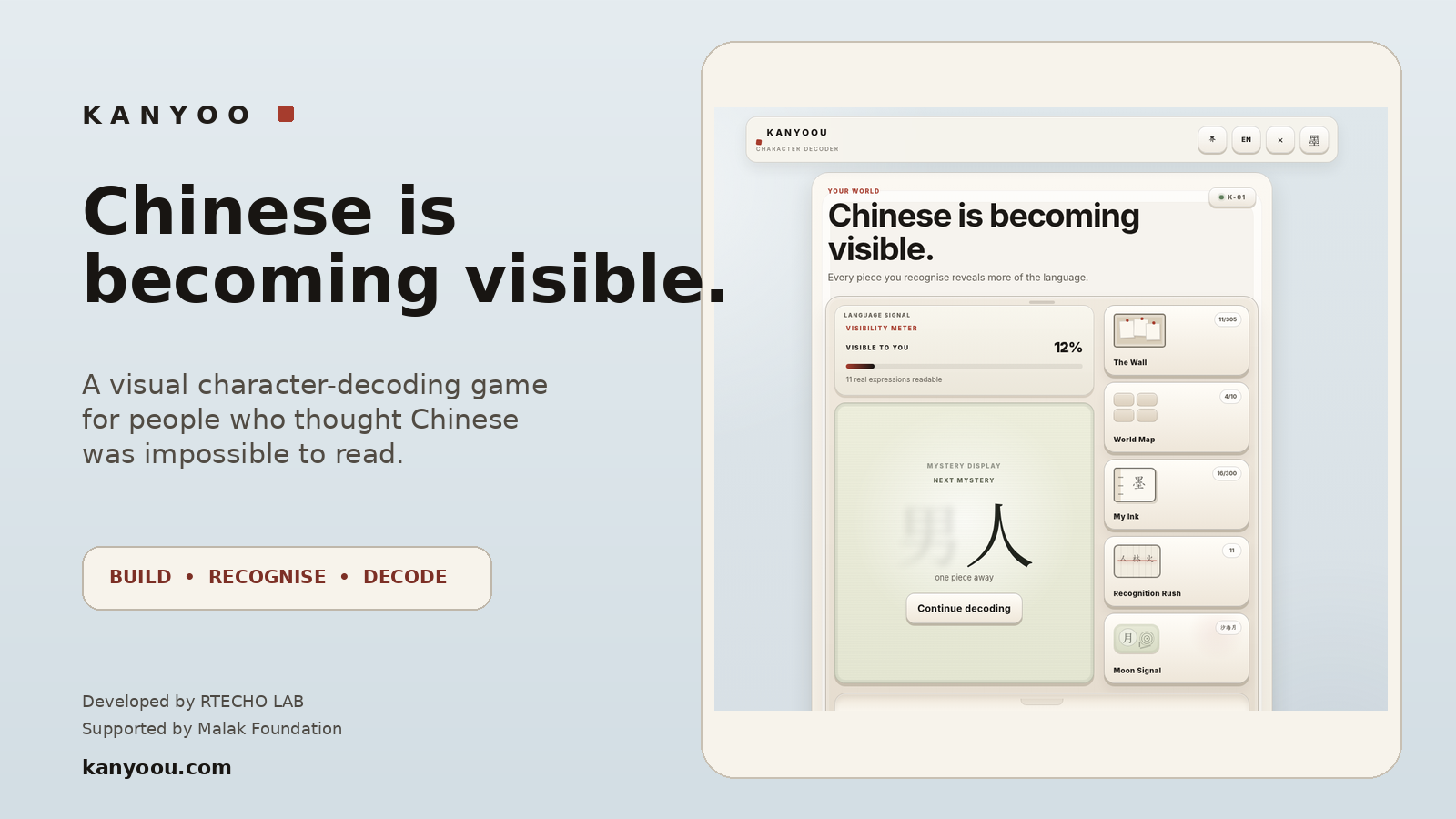
Chinese can look impossible — until the patterns begin to appear
For many people who have never studied Chinese, written Chinese can feel almost impossible to decipher.
Unlike languages that use familiar alphabets, a Chinese character may initially appear as a completely unfamiliar symbol with no obvious way to sound it out, separate it into pieces, or guess what it might mean.
Kanyoou was created around a simple idea: what if the first experience of Chinese was not a lesson, but discovery?
Malak Foundation is pleased to support the launch of Kanyoou, a browser-based visual character-decoding game developed by RTECHO LAB.
Rather than asking a new player to memorise vocabulary or complete traditional language exercises, Kanyoou invites them to touch, build, recognise and gradually decode Chinese characters.
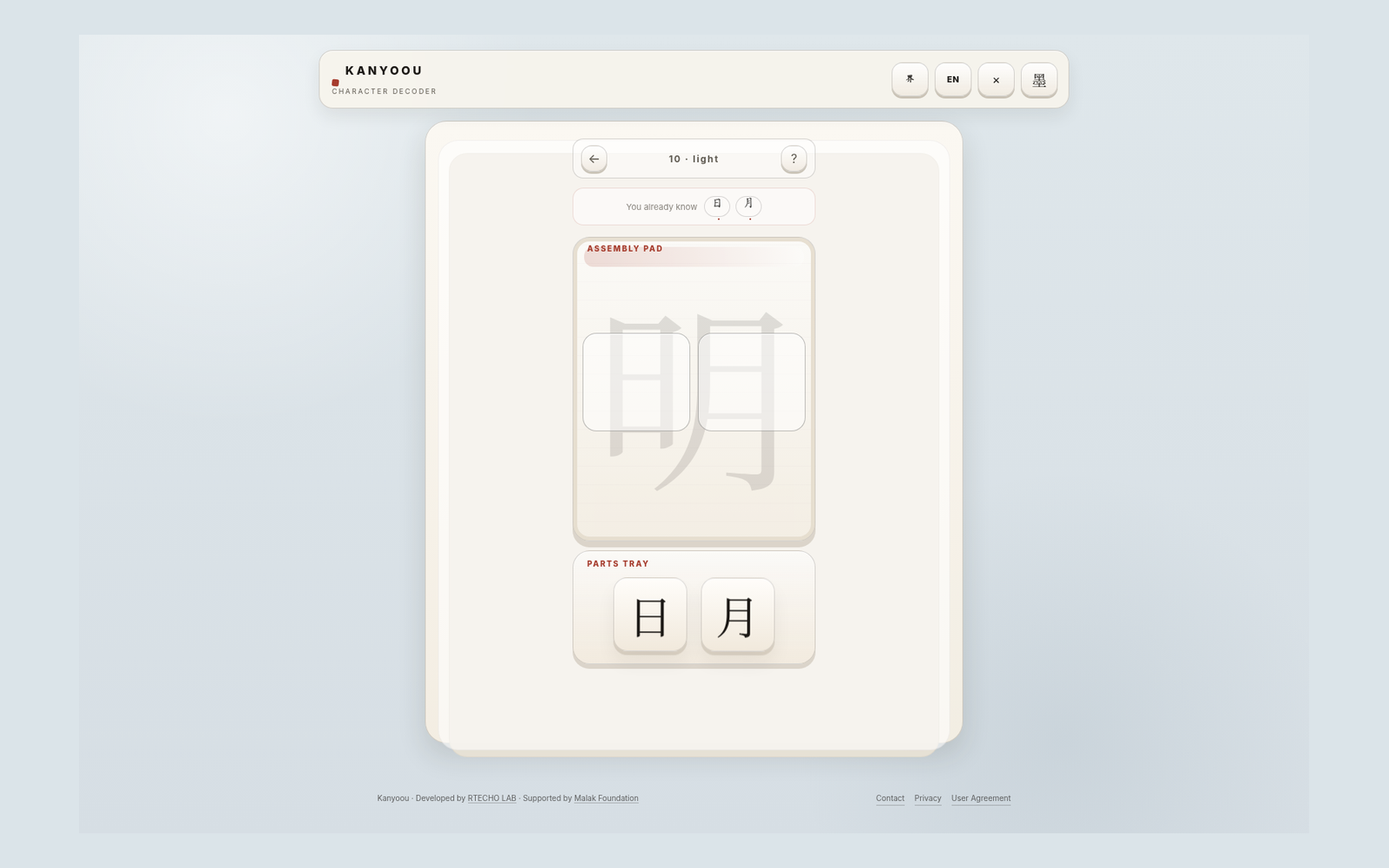
A character may begin as several unfamiliar pieces.
The player moves those pieces into place, watches the completed character reveal itself, hears its Mandarin pronunciation, and then begins seeing that same structure appear again in new characters and real Chinese expressions.
Chinese slowly becomes familiar
The idea behind Kanyoou is not that Chinese is “easy.”
It is that Chinese is not random.
As players progress, familiar pieces begin appearing inside things they have never seen before.
A character learned earlier can suddenly unlock several new words.
An expression that was mostly blurred can become partially readable.
Something that looked completely opaque on the first day can later produce the reaction:
“I know that character.”
Kanyoou has been designed around that moment.
The launch version contains a growing world of character discoveries, real expressions, themed areas and longer-running mysteries.
Players can build characters on the Assembly Pad, explore their growing collection through My Ink, revisit real expressions on The Wall, move between themed areas on the World Map, and test visual recognition through Recognition Rush.
Rather than presenting hundreds of lessons in a long course list, Kanyoou tries to make progress feel like uncovering an unfamiliar world.
The Kanyoou Assembly Pad turns Chinese characters into tactile visual puzzles.
Designed to feel like a device, not a classroom
Kanyoou deliberately avoids looking like a conventional language-learning platform.
Its interface takes inspiration from an earlier philosophy of personal computing: unfamiliar technology became easier when functions were represented as understandable objects that lived in predictable places.
Kanyoou applies that same idea to language.
The Wall is always a Wall.
My Ink feels like a field notebook.
Character pieces sit inside a Parts Tray.
New mysteries appear on a dedicated display.
Over time, players learn where everything lives without repeatedly navigating menus.
The result is intended to feel more like using a small character-decoding device than opening an online course.
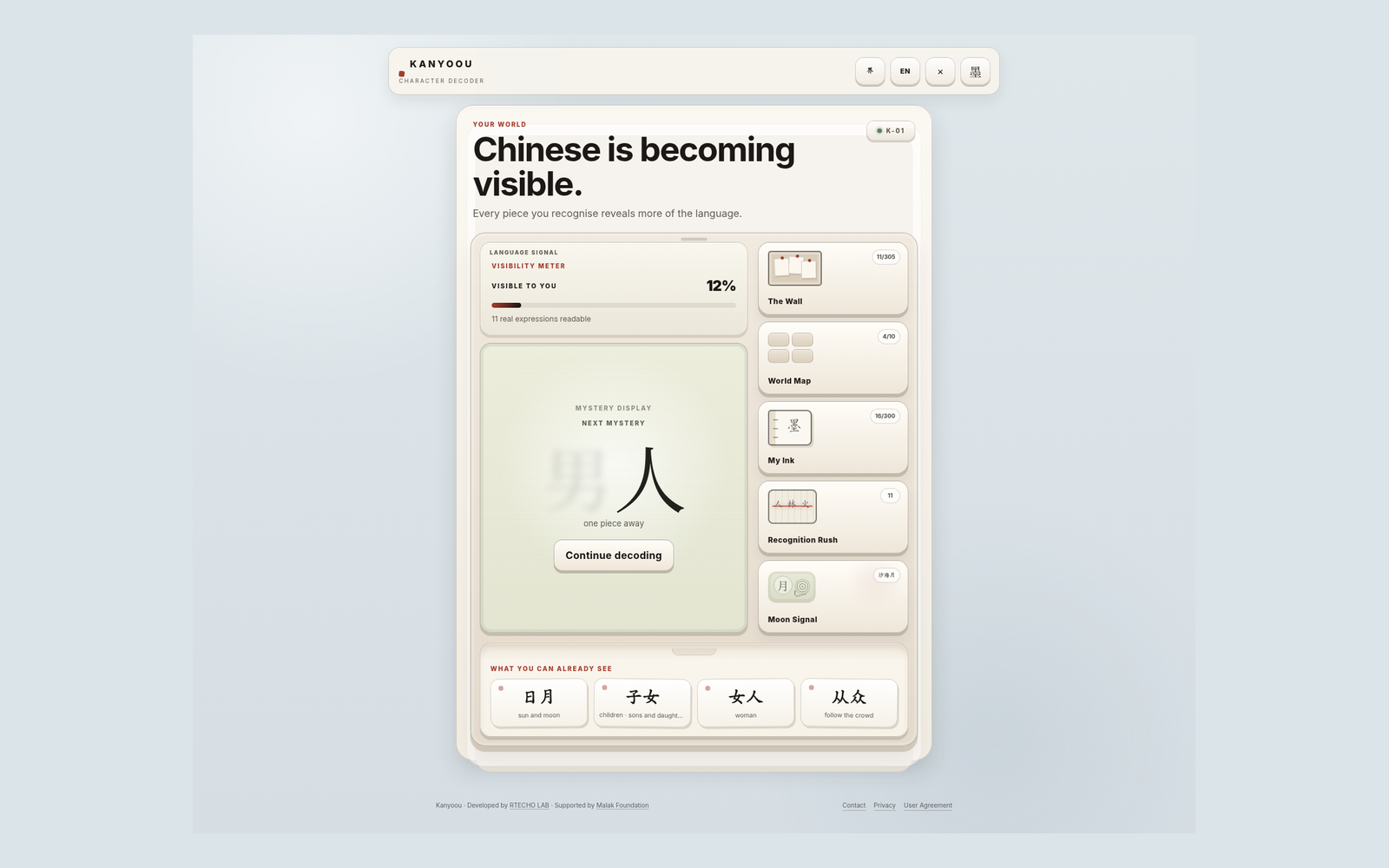
The Kanyoou Device World gives each activity a fixed place, helping players build familiarity through spatial memory.
The language reveals itself over time
One of the most important parts of Kanyoou is The Wall.
The Wall contains real Chinese expressions.
Characters the player already knows appear clearly.
Characters they have not yet encountered remain partially hidden or misted.
As more characters are discovered, the Wall becomes progressively more readable.
This creates a very different kind of progress.
Instead of seeing:
“Level 24 complete”
the player begins seeing:
“I can actually read this now.”
That shift from completing lessons to recognising real language is central to the Kanyoou experience.
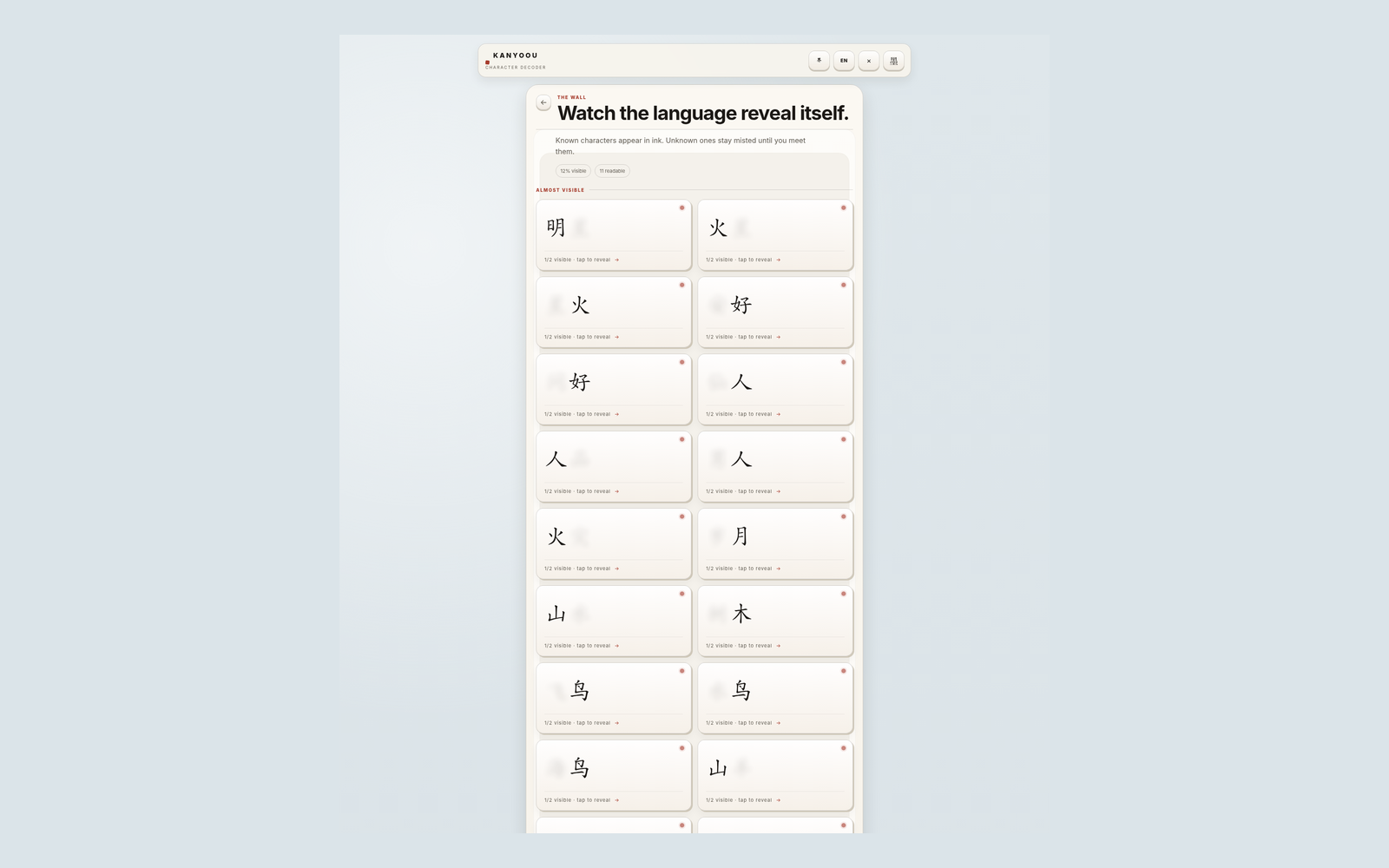
Known characters gradually become visible on The Wall, turning unfamiliar Chinese into recognisable language.
A melody connected to the experience
Kanyoou also has its own musical identity.
The original song 沙海月 — Moon Signal has been incorporated into the experience at selected emotional moments rather than playing continuously in the background.
A short motif appears when a new player begins.
The melody returns at an important early milestone.
The full song can also be revisited through the Moon Signal station inside the Kanyoou Device World.
The intention is simple:
as players build memories around discovering the language, the music gradually becomes connected to those memories too.
Learning through recognition, curiosity and play
Kanyoou is designed especially for people who may previously have looked at Chinese and thought:
“There is no way I could understand that.”
The game does not require previous Chinese knowledge.
Players are encouraged to recognise patterns, make guesses and follow their curiosity.
Incorrect choices are handled gently rather than through lives, penalties or harsh failure screens.
As the experience becomes more complex, previously learned pieces continue to return.
The player is therefore not constantly starting again.
Ideally, the feeling becomes:
“This is new — but part of it is already familiar.”
That is the experience Kanyoou is trying to create.
Built for an international audience
Kanyoou has been designed as a web experience so people can access it directly through a browser without first installing a large application.
The current release also supports an interface designed for international audiences, while the central gameplay depends heavily on visual interaction rather than lengthy instructions.
No account is required for the current release.
Progress is stored locally in the user’s browser, helping keep the initial experience simple and reducing unnecessary collection of personal information.
Developed by RTECHO LAB, supported by Malak Foundation
Kanyoou has been developed by RTECHO LAB, with support from Malak Foundation.
For Malak Foundation, supporting this project reflects a broader interest in technology that can make learning, cultural engagement and participation more approachable to people from different backgrounds.
A writing system that once appears completely foreign can become more familiar one pattern at a time.
Kanyoou begins there.
See Chinese differently.
Build it. Recognise it. Decode it.
