Parliamentary Report on Australia–Africa Relations
The Joint Standing Committee on Foreign Affairs, Defence and Trade (JSCFADT) Parliamentary Report on Australia–Africa Relations
Malak Foundation welcomes the parliamentary report, Strengthening Australia’s trade and investment relations with the countries of Africa, and its recommendations for deeper, more coordinated engagement between Australia and African nations.
The report offers an important opportunity to recognise the knowledge, relationships and capabilities that African-Australian communities bring to Australia’s international engagement. We particularly welcome the recommendations to establish an Australia–Africa Advisory Council and a formal African Diaspora Engagement Framework, including an African Diaspora Unit within the Department of Foreign Affairs and Trade.
These recommendations provide a foundation for a more sustained partnership between government, communities, universities and industry.
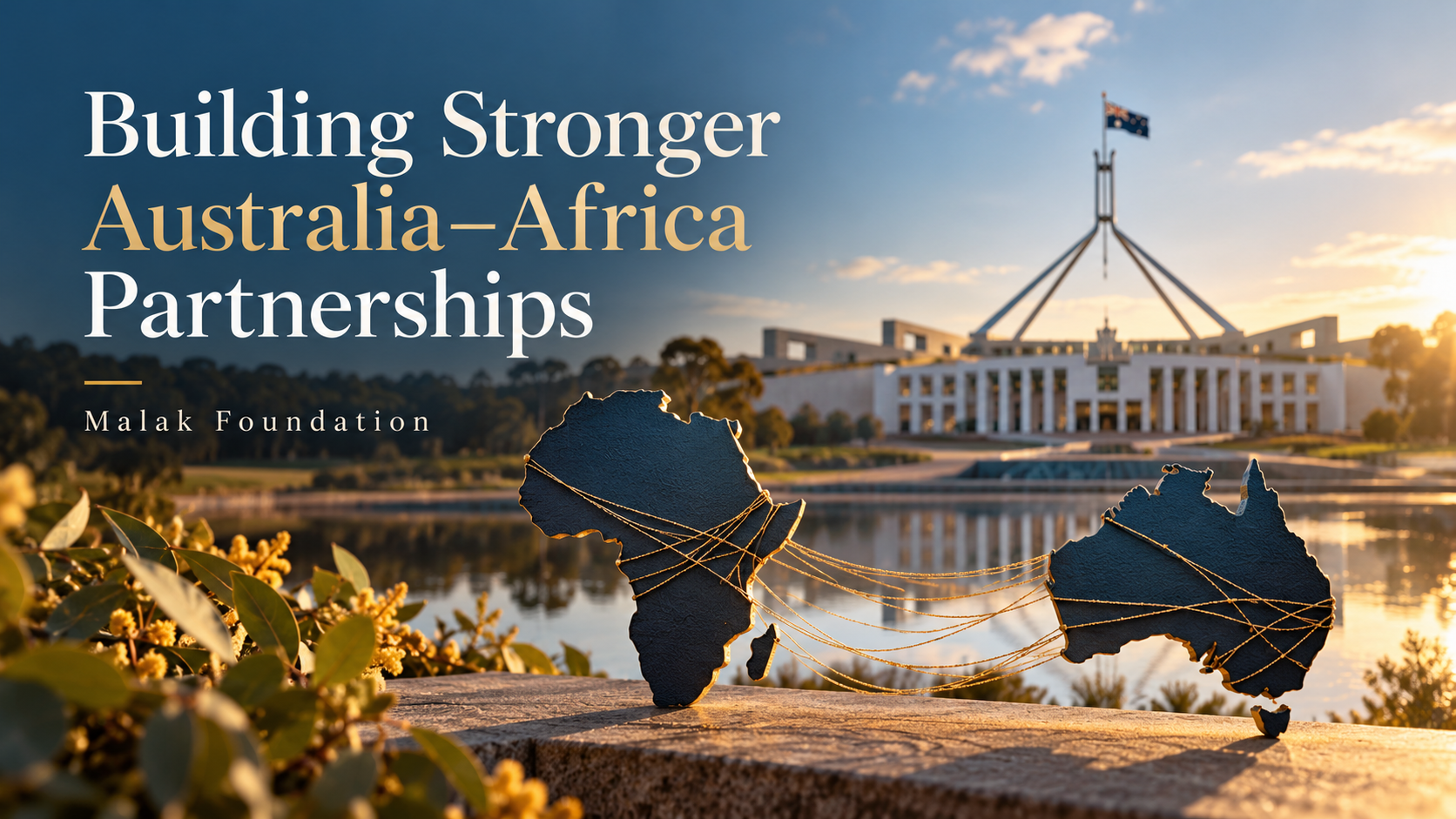
Building the conversation together
Over the past two years, Malak Foundation has worked with partners and stakeholders to advance the conversation about Australia’s relationship with Africa. Our engagement has focused on the contribution of diaspora communities, stronger institutional connections, and practical opportunities for cooperation across education, community development, trade and cultural exchange.
Throughout this work, we have advocated for African-Australian communities to be recognised as active contributors to policy and partnership development. Their professional expertise, cultural knowledge and connections across both continents can help Australia build more informed and enduring relationships.
We acknowledge the valuable contributions of Associate Professor David Mickler, the Centre for Australia–Africa Relations at Curtin University, the Australia Africa Universities Network, and the many community organisations, researchers, businesses and diplomatic representatives who have advanced this discussion.
The report reflects a collective effort. Its value lies in bringing these perspectives together and identifying practical directions for the future.

Malak Foundation’s contribution
Malak Foundation’s submission proposed an Australia–Africa Diaspora Council supported by a practical governance framework for structured engagement, advice and partnership development.
We are pleased that paragraph 5.30 of the final report explicitly acknowledges our proposal and our engagement with the Australian Government. The report also cites Malak’s evidence in its discussion of underutilised diaspora capabilities and barriers to trade.
Recommendations 13 and 14 substantially align with our call for continuing diaspora participation and a national advisory mechanism. While the detailed arrangements remain for government consideration, these recommendations create an opportunity to explore how effective, inclusive structures could operate.
Creating practical connections through AFRAUSN
Alongside our policy engagement, Malak Foundation hosts AFRAUSN—the Africa–Australia Community Network, a free, voluntary directory and network designed to help African-Australian community organisations become more visible, find partners and access consultation opportunities.
AFRAUSN respects the independence of each participating organisation. It does not speak on behalf of African-Australian communities or adopt policy positions for its members. Its purpose is to make connections easier while allowing organisations to contribute in their own voices.
This practical approach complements Malak’s broader commitment to stronger relationships: helping organisations find one another, share opportunities and engage with institutions on matters relevant to their communities.
Looking ahead to the Government’s response
We look forward to the Australian Government’s response to the report and the opportunity to contribute constructively to the next stage.
Malak Foundation stands ready to support DFAT’s Africa Branch and other stakeholders as they consider the recommendations and explore possible implementation models. We would welcome opportunities to share our governance work, contribute community perspectives and assist with consultation and partnership development.
Effective implementation will require clear responsibilities, transparent participation, achievable priorities and measurable outcomes. It will also need to reflect the diversity of African countries and African-Australian communities, including the perspectives of women, young people and smaller community organisations.
We thank the Committee, its secretariat and all contributors for their work. We look forward to continuing alongside our partners to help translate this parliamentary milestone into lasting relationships and practical opportunities for communities across Australia and Africa.